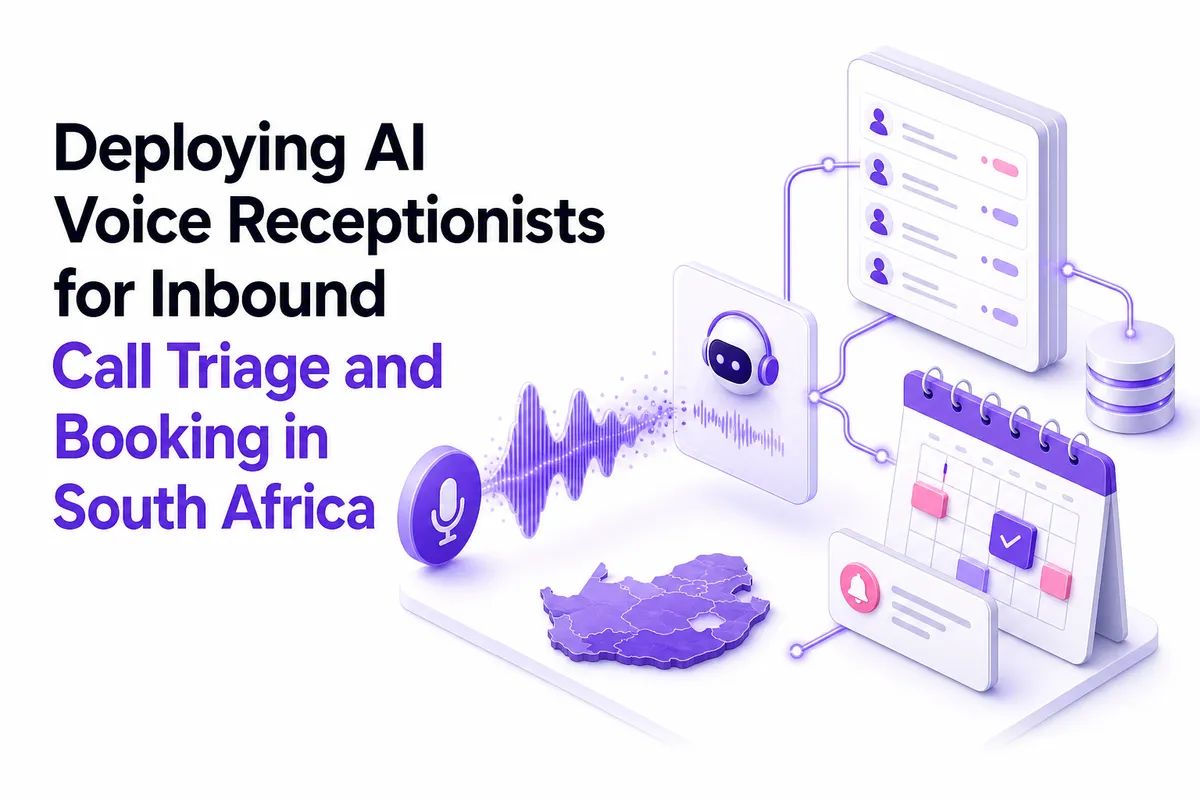
Deploying AI Voice Receptionists for Inbound Call Triage and Booking in South Africa
Discover how South African businesses replace keypress phone menus with AI voice receptionists that handle customer enquiries, update CRMs, and maintain POPIA compliance.
Why Traditional Phone Menus Cost South African Businesses Revenue
For decades, businesses across South Africa relied on interactive voice response systems that instructed callers to press specific numbers on their keypads. These rigid menus frustrate customers with urgent or nuanced requests. When callers encounter looping prompts or failed transfers, they frequently hang up and contact a competitor instead. According to research cited by [whichvoip.co.za](https://whichvoip.co.za/phone-systems/ai-agent-to-answer-business-calls/), the default voicemail message loses roughly two-thirds of business calls because callers hang up rather than wait.
Modern AI voice technology shifts this experience from keypad navigation to natural conversation. An AI receptionist listens to spoken words, identifies caller intent, and responds immediately — allowing the caller to say what they need rather than decode a menu. This is particularly valuable in South Africa, where connectivity disruptions and demanding schedules make prompt, accurate first contact critical. Businesses that answer every call instantly, capture caller details, and route requests intelligently recover pipeline that rigid IVR systems routinely discard.
How Conversational AI Agents Handle Inbound Voice Workflows
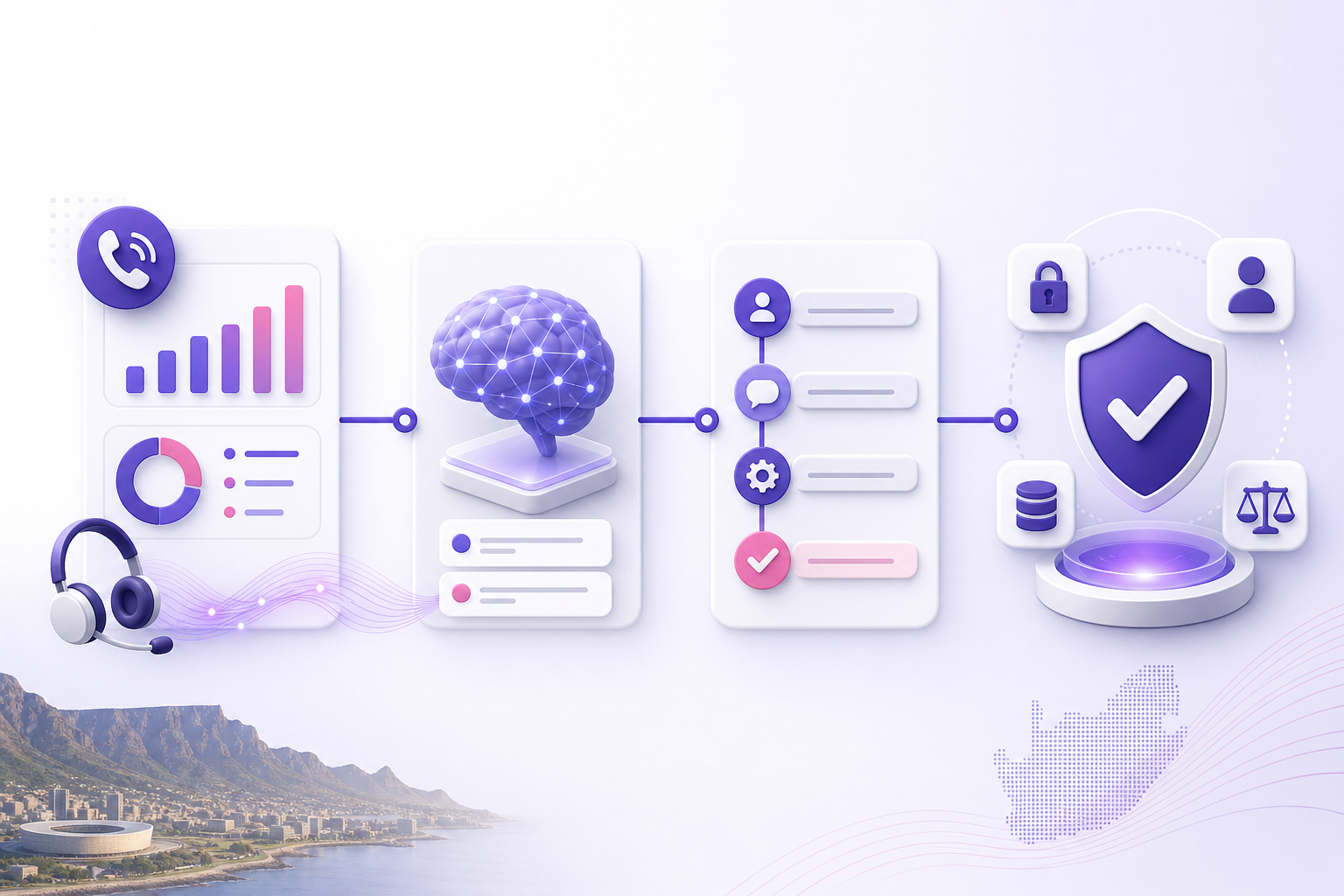
When a call lands on a business number, audio streams to a speech-to-text engine, a language model reads the transcript alongside a brief describing the business, and a text-to-speech voice replies on the line. According to [itweb.co.za](https://www.itweb.co.za/article/ai-voice-agents-poised-to-revolutionise-sas-digital-customer-service/nWJadMbNQQlMbjO1), leading South African deployments use locally hosted speech recognition to reduce latency, followed by natural language understanding and retrieval-augmented generation — grounding the AI's responses in the organisation's own data rather than general internet knowledge. A working agent can answer, book into a live calendar, capture caller details, and send a WhatsApp or SMS confirmation.
Beyond answering routine enquiries, these agents integrate directly with calendar applications and CRM platforms. When a customer requests an appointment, the system checks real-time availability, proposes suitable slots, and records the booking during the live call. The agent simultaneously creates or updates the caller's CRM profile, logs a transcript summary, and flags actionable follow-up items for staff. As [1stream.co.za](https://1stream.co.za/south-african-call-centres-ai-voice-agent-roi-calculator-business-case/) notes, when an AI voice agent hands over to a human, the agent already sees what was said, what was verified, and what the customer wants — eliminating the frustrating repeat-yourself moment.
Where AI Voice Agents Deliver the Most Consistent Value
The interactions AI voice handles best are those that follow a predictable pattern: appointment scheduling, lead qualification, after-hours call capture, and routine status enquiries. Booking is the clearest example because the workflow is identical every time — the agent checks live availability, offers slots, confirms the booking, and writes the appointment back to the practice management or scheduling system. Professional services, healthcare practices, automotive workshops, and salons are among the business types where this use case is most straightforward to deploy, according to [whichvoip.co.za](https://whichvoip.co.za/phone-systems/ai-agent-to-answer-business-calls/).
Not every inbound call is suitable for full automation. High-stakes, one-off conversations — custom valuations, complex legal intake, sensitive complaints — require human judgment on the first contact. The appropriate deployment model uses the AI as a triage layer that qualifies the call, captures context, and routes it with a full transcript to the right human, rather than attempting to close the interaction autonomously. Recognising this boundary before deployment prevents the most common failure mode: routing calls that need empathy and discretion to a system that can only follow a script.
Operational Differences Between Voice Technologies
Selecting the right inbound communication platform requires understanding how traditional IVR compares with agentic AI across core operational functions. As [whichvoip.co.za](https://whichvoip.co.za/phone-systems/ai-voice-agent/agentic-ai-to-handle-inbound-calls/) summarises: an IVR is a switchboard operator, a chatbot is a receptionist with a FAQ document, and an agentic AI is a junior personal assistant that can check calendars, book meetings, qualify leads, and create support tickets directly in your systems.
The four capability differences below illustrate why growing South African organisations are retiring keypress menus in favour of conversational agents that support both callers and internal teams.
Natural Dialogue vs. Keypress Menus
Legacy IVR restricts callers to numbered choices. AI voice interprets spoken intent — including location, timing and service type in a single sentence — and moves the call forward without looping menus or dead ends.
Live CRM and Calendar Sync
Traditional phone trees capture nothing. AI receptionists log transcript summaries, update customer records, sync bookings, and trigger follow-up tasks across connected platforms during the live call.
Around-the-Clock Availability
Manual reception desks face capacity limits and after-hours downtime. Cloud-based AI voice agents handle incoming calls continuously, recovering after-hours pipeline without overnight staffing costs.
Governed Data Handling
Purpose-built AI voice platforms apply risk-based privacy controls — such as automatic PII redaction, structured audit trails, and access governance — to protect caller data and support compliance obligations.
How to Deploy an AI Voice Agent Responsibly
A successful deployment starts with definition, not technology. Map the top inbound call intents from your call history — booking requests, pricing enquiries, directions, account queries — and document accurate answers for each. Establish clear escalation rules that specify exactly when the AI must transfer to a human: low confidence scores, VIP callers, emergency reports, or any query type outside the agent's defined scope. Then select a provider with robust API integrations to the calendars, CRMs, and helpdesks your team already uses, as [whichvoip.co.za](https://whichvoip.co.za/phone-systems/ai-voice-agent/agentic-ai-to-handle-inbound-calls/) highlights — integration capability is the most critical technical criterion.
Once integrations are confirmed, configure the agent with your business rules, persona, and constraints, then run rigorous internal testing before live calls. Pilot on a limited call subset — after-hours traffic is a practical starting point — and review transcripts daily during the first weeks. Identify where the agent hesitates or misroutes, refine conversation flows, and adjust confidence thresholds. As [itweb.co.za](https://www.itweb.co.za/article/ai-voice-agents-poised-to-revolutionise-sas-digital-customer-service/nWJadMbNQQlMbjO1) notes, human teams continue to monitor performance, update information, and control escalation rules — the AI acts as a first-line assistant, not a set-and-forget replacement.
Managing Compliance, Latency, and Technical Boundaries
Under Section 19 of POPIA, organisations must implement appropriate and reasonable technical and organisational measures to protect personal information — the specific controls selected should be proportionate to the organisation's data processing activities and the risks involved. In a voice AI environment, safeguards that may be appropriate include encrypting stored call data, applying automatic redaction of sensitive caller details, maintaining structured audit trails, and governing database access according to staff roles.
These are examples of risk-based choices, not a statutory checklist; the right combination depends on what personal information is processed and how. The [aiautomatedsolutions.co.za](https://aiautomatedsolutions.co.za/post/receptionist-20-why-ai-beats-old-school-ivr) AI Receptionist product, for instance, stores consent events, templates used, and call outcomes on the contact record in a CRM — an approach designed to support auditability without relying on screenshots and spreadsheets.
Beyond privacy, South African businesses should account for a specific deployment risk: latency accumulation. As [techcentral.co.za](https://techcentral.co.za/lost-in-translation-why-ai-voice-agents-fail-south-africans/282607/) reports, the common failure mode is the bolted-on approach — integrating an AI layer over existing telephony infrastructure without accounting for the latency that builds up at each processing step. Locally hosted speech-to-text engines can help reduce this gap, but they do not eliminate every variable. Businesses should verify end-to-end response times during testing rather than assuming a smooth caller experience from day one. AI voice also cannot reliably handle severe background noise, poor cellular connectivity, or queries that require human empathy and policy judgment — knowing these boundaries in advance shapes a deployment that sets accurate expectations for both callers and staff.
Important: This article provides general business information, not legal, tax or financial advice. Confirm requirements for your circumstances with a suitably qualified professional.