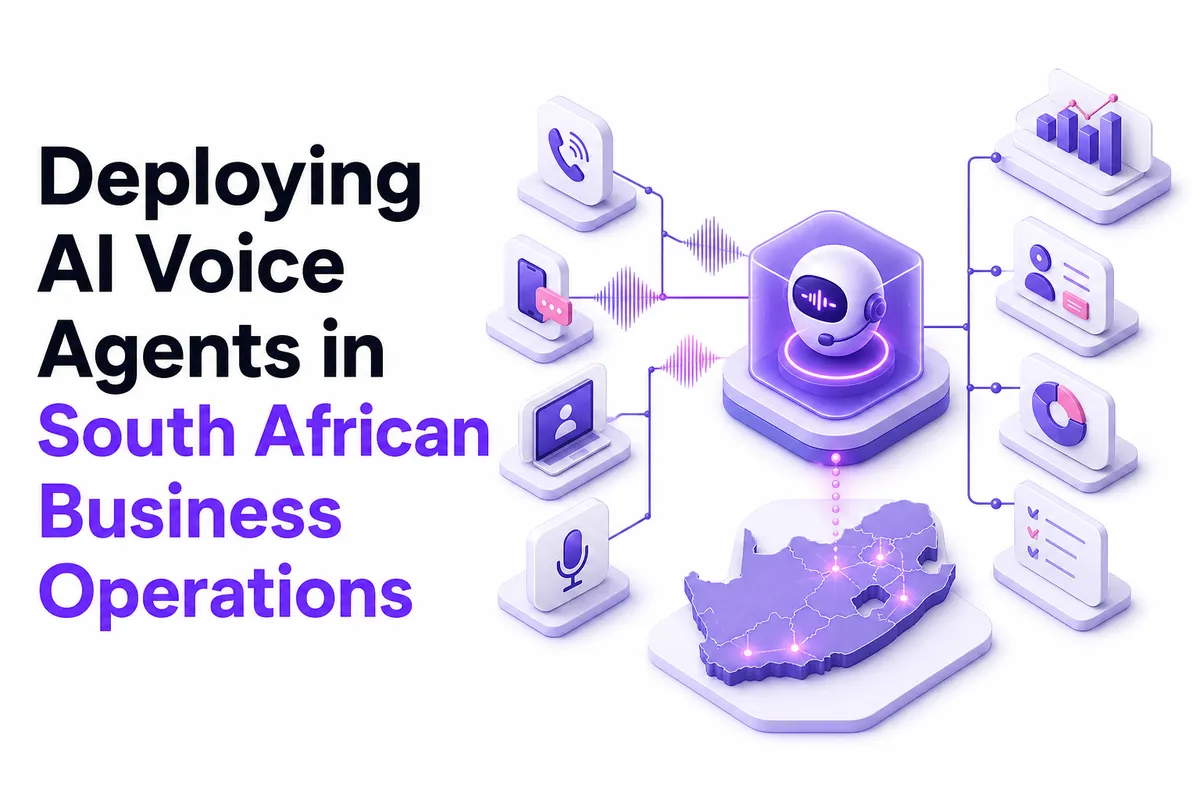
Deploying AI Voice Agents in South African Business Operations
A practical guide for South African operational leaders on evaluating AI voice receptionists, managing audio latency, and aligning phone automation with local privacy standards.
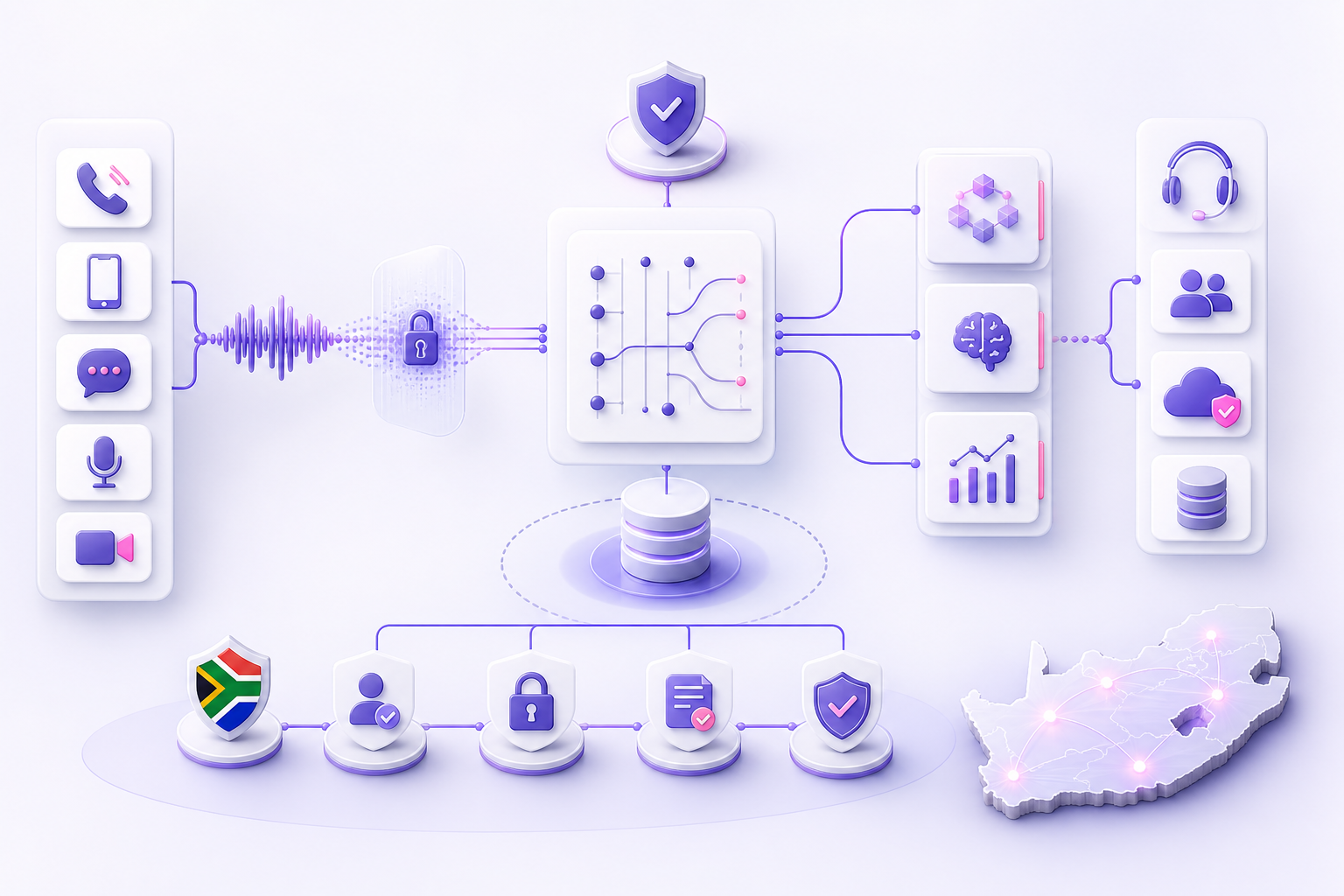
Why South African Businesses Are Rethinking the Phone Channel
Rapid shifts in conversational technology are prompting South African businesses to evaluate AI voice agents for frontline reception. Unlike rigid phone menus, these agents handle spoken inquiries naturally, qualifying leads, booking appointments, and routing calls based on intent. For operational leaders managing high call volumes with limited front-desk capacity, voice automation converts unstructured phone traffic into structured business data while reducing caller wait times.
Deploying voice agents successfully requires evaluating technical and regulatory variables specific to South Africa. Callers expect fluid turn-taking, so latency, accent handling, and telephony integration all matter. Business leaders must look beyond software marketing to understand how voice automation fits daily workflows, what infrastructure it demands, and which compliance obligations attach before the first call is answered.
Latency, Local Routing, and Telecom Integration
Human conversation depends on precise timing. Industry analysis indicates that response delays below roughly 300 milliseconds can sound abrupt, while delays beyond approximately 700 milliseconds signal to callers that a machine is struggling. Routing South African voice traffic through distant international cloud nodes adds latency that can push responses into that uncomfortable range. Locally hosted media endpoints, or SIP trunks connected to South African infrastructure, help keep end-to-end response times within the natural conversational window. ICASA-licensed carriers, or international carriers with South African direct inward dial numbers, are the licensed termination options; the AI software layer itself does not require an ICASA licence, but the underlying carrier must hold the appropriate Electronic Communications Service licence.
South African speech is linguistically diverse. Global speech recognition models trained predominantly on overseas audio often stumble on local accents and code-switching patterns common in Afrikaans-, isiZulu-, or isiXhosa-influenced English. Vendors who have invested in fine-tuning with local voice talent and regionally representative datasets produce noticeably more reliable transcription. Before committing to a platform, test it with your own staff using real customer phrasings in every language your callers use. Integration with existing PBX systems should occur via a documented API or hosted-PBX connection, avoiding the need to replace functional telephony infrastructure.
POPIA Obligations Before Your Agent Takes Its First Call
An AI voice agent that records and transcribes callers is processing personal information, which brings it squarely under the Protection of Personal Information Act. Section 19 requires appropriate, reasonable technical and organisational measures selected according to the sensitivity and risk of the processing involved. Controls such as encrypted transcript storage, role-based access, defined retention periods, and audit logging are examples of the kinds of measures an organisation might reasonably select — they are not a statutory checklist prescribed by name.
Open every call with a recorded disclosure informing the caller that the interaction is handled and recorded by an AI system, which addresses the lawful-basis and openness requirements. Your AI provider acts as an operator; require a signed Data Processing Agreement before going live.
For outbound automated calls used in direct marketing, section 69 of POPIA treats telephone calls as electronic communications. Prior consent is required unless the recipient is an existing customer and the conditions set out in section 69(3) are met. Responsible deployments focus outbound voice agents on permission-based operational scenarios — appointment confirmations, delivery updates, or renewal notifications — which can support regulatory compliance and improve call acceptance. Where call audio or transcripts are processed offshore, section 72 cross-border transfer safeguards apply. South Africa has not yet published formal adequacy decisions for other countries, so the contractual requirements for lawful cross-border transfers are more demanding than a generic data agreement.
A Hypothetical Look at AI Reception in a Healthcare Setting
As a hypothetical illustration, consider a multi-branch specialist medical practice experiencing high inbound call volume during morning scheduling hours. Receptionists are occupied with in-person check-ins while the phone queue grows, resulting in missed calls and delayed bookings. In this scenario, the practice deploys an AI voice receptionist connected to its existing cloud PBX to handle routine appointment queries, freeing clinical administration staff for higher-complexity tasks.
The agent is configured with scripts suited to local English pronunciations and common medical vocabulary. It opens each call with a clear disclosure about AI handling and recording, establishing the lawful basis for processing. For routine queries it checks availability and routes the outcome to the appropriate workflow; for complex or sensitive requests it executes a warm transfer so the caller reaches a human without repeating their details. Crucially, this scenario is illustrative — it describes a plausible deployment pattern, not a documented client result, and no performance figures are attributed to it.
Choosing the Right Voice AI Architecture for Your Business
No single deployment model suits every organisation. The right choice depends on call volume, existing telephony infrastructure, available technical capability, and how deeply the agent needs to interact with operational systems such as CRMs or scheduling platforms. The cards below outline four common approaches to help leaders frame their evaluation.
When assessing options, prioritise long-term maintainability, integration fit with your current stack, clear ownership of the voice workflow, and the vendor's ability to explain how your data is handled. A solution that works smoothly in a demo but cannot be monitored, adjusted, or audited by your own team creates operational risk over time.
Turnkey Cloud Reception
Pre-configured services for basic inbound routing and message capture. Minimal setup for small teams, though integration depth with existing CRMs may be limited.
Hybrid PBX SIP Trunking
Connects AI voice endpoints to your existing phone system via SIP. Retains call routing control and can reduce latency by keeping traffic on local infrastructure.
Enterprise API Orchestration
Custom workflows linking speech engines to operational databases. Maximum control over data handling and business logic, requiring dedicated technical maintainability.
Human-in-the-Loop Triage
The agent gathers initial caller context before transferring to staff. Improves productivity while ensuring complex or sensitive calls receive immediate human attention.
Three Foundational Steps Before Going Live
Map call flows and triage criteria before selecting any technology. Identify the high-volume, repetitive inquiries your agent will handle — scheduling, directions, order status — and define clear escalation rules specifying exactly when and how the agent must transfer to a human. Callers must always be able to reach a person; a frustrated caller trapped in a loop with no exit is both a service failure and a reputational risk. Test the escalation path as rigorously as the core call flow, and confirm that the telephony routing selected keeps end-to-end response times within the conversational range for South African callers.
Establish privacy safeguards before the first live call. Configure the opening disclosure, agree a defined retention period for recordings and transcripts with your provider, and document the technical and organisational measures you have selected and why, proportionate to the sensitivity of what your callers share. Implement a working process for data-subject access and deletion requests, since the Information Regulator does respond to complaints. Review transcripts regularly to refine agent scripts, monitor transfer performance, and confirm the system continues to behave as intended as call patterns evolve.
Important: This article provides general business information, not legal, tax or financial advice. Confirm requirements for your circumstances with a suitably qualified professional.