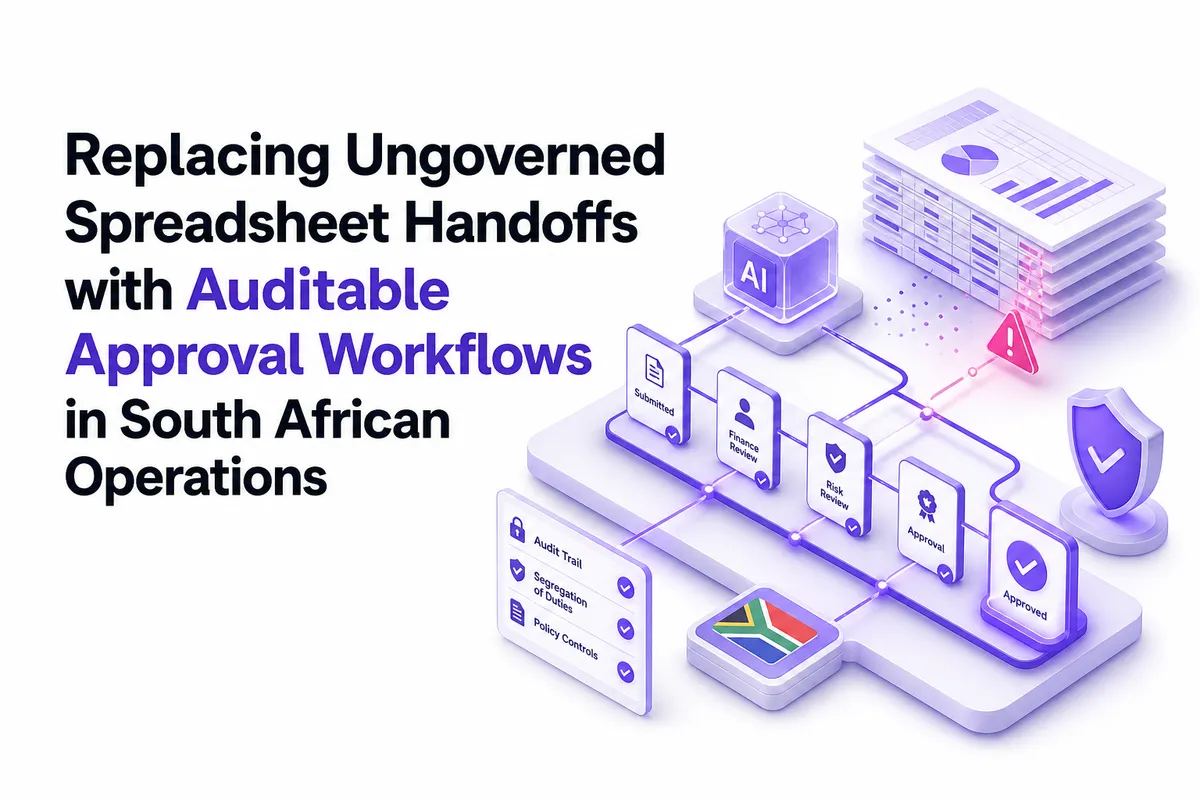
Replacing Ungoverned Spreadsheet Handoffs with Auditable Approval Workflows in South African Operations
Learn how South African businesses can replace manual spreadsheet handoffs with auditable, automated approval workflows that improve reliability, reduce processing friction, and support data compliance.

The Hidden Vulnerability of Manual Handoffs in Business Workflows
Many South African companies rely on email threads and shared spreadsheets to manage critical operational handoffs, including vendor payments and capital expenditure approvals. While spreadsheets offer initial flexibility, they lack automated validation rules and immutable audit trails. When financial records move manually between department leads and approvers, operational risks compound. Version control errors and missing authorization context frequently lead to processing delays and unverified financial exposures.
Transitioning from disconnected spreadsheets to structured digital approval workflows replaces manual re-keying with automated data transfers and status tracking. A structured workflow ensures that each task moves sequentially based on established business logic. Instead of chasing approvals over email or searching for spreadsheet revisions, team members interact with central forms and explicit tasks, ensuring that critical governance checks occur before actions are finalized.
Automating handoffs enforces consistency at every stage of an operational process. By defining role-based access controls and explicit condition checks, organisations ensure that high-value transactions receive appropriate oversight. Line managers gain real-time visibility into open approvals, bottlenecks are identified quickly, and administrative overhead is reduced, enabling finance and operations teams to focus on core strategic execution rather than manual administrative correction.
Evaluating Manual Spreadsheet Handoffs Against Automated Approvals
Comparing traditional spreadsheet management with automated approval workflows highlights essential operational differences in reliability, processing speed, and governance capabilities. While manual spreadsheet processes rely entirely on individual staff discipline to maintain formula integrity and track revisions, automated workflow platforms embed business logic, data validation rules, and authorization boundaries directly into software architecture.
To evaluate whether your enterprise should transition away from manual spreadsheet sign-offs, consider how these two operational models perform across essential administrative functions. Comparing these approaches clarifies how automated systems strengthen authorization logging, preserve data integrity across handoffs, uphold information security safeguards, and maintain process visibility during busy trading periods.
Authorization Tracking
Spreadsheets record numbers without verifying who approved specific edits or budget updates. Automated workflows capture detailed event logs, including exact timestamps, identity verification, and delegation histories, ensuring complete operational transparency for internal governance and audit reviews.
Data Integrity Safeguards
Manual data entry across disconnected spreadsheets increases the risk of broken formulas, overwritten calculations, and duplicate entries. Automated approval engines validate inputs at entry point, enforcing mandatory fields and cross-referencing live databases before submission.
Information Security Controls
Emailing financial spreadsheets creates uncontrolled copies containing sensitive business data across inbox backups and local hard drives. Automated platforms restrict access through role-based permissions, enforcing targeted view rights and secure controls across all operational devices.
Operational Bottleneck Visibility
Spreadsheet processes obscure pending approvals, forcing managers to send manual reminders and search email threads. Automated workflows provide real-time status dashboards, trigger automated escalation prompts, and highlight delayed approval stages without requiring manual administrative intervention.
A South African Operational Example: Capital Expenditure Sign-Offs
Consider a South African commercial property management company operating across Gauteng and the Western Cape that manages capital expenditure requests for building maintenance. In a manual operational setup, site managers complete expenditure spreadsheets and attach quotes before emailing the package to regional portfolio directors. Once regional directors review the request, they forward the spreadsheet to the chief financial officer for final payment clearance.
In this manual process, several operational issues frequently arise. Spreadsheet formulas calculating total job costs are occasionally overwritten by local facility managers, leading to unverified budget variances. Financial controllers receive files missing vendor tax numbers or compulsory compliance documents, requiring back-and-forth emails that delay urgent maintenance work. Additionally, tracking approval history for annual financial audits requires hours of manual document collection.
When the business replaces this spreadsheet chain with an automated approval workflow, the intake form validates quote details and checks expenditure thresholds automatically. Requests under pre-set operational limits route directly to regional managers, while larger capital requests automatically escalate to executive approvers with required supporting documents attached. The system logs every review step automatically, providing clear visibility into pending requests without copying data manually.
Four Steps to Transitioning Away from Ungoverned Spreadsheet Handoffs
Successfully replacing spreadsheet handoffs requires a methodical deployment strategy that addresses operational governance, enterprise software integration, and team adoption. Attempting to digitize complex approval processes without prior process mapping risks transferring inefficient operational habits into new software platforms, creating unnecessary administrative complexity and operational confusion for department teams during daily financial sign-offs.
Following a structured step-by-step methodology enables South African businesses to maintain daily operational continuity while establishing robust digital controls. This phased approach ensures that core business rules, financial authorization limits, and data validation controls are rigorously tested and verified before legacy manual spreadsheets are completely phased out from daily operational workflows.
Establishing clear governance milestones at each phase ensures that process owners, finance leads, and executive approvers remain fully aligned throughout the workflow modernization project. Regular operational reviews during deployment allow administrators to fine-tune notification triggers, adjust delegation paths, and verify that audit logging operates effectively across all internal operational units.
Map Process Rules and Approval Escalations
Document the actual path that operational requests follow, including decision thresholds, delegation rules, and required documentation. Identify every point where spreadsheets currently move between departments to establish explicit routing logic for the automated system.
Standardize Digital Intake Forms and Validation
Replace unstandardized spreadsheet attachments with structured web forms that enforce data validation rules at the point of submission. Mandatory input fields ensure that operational teams provide all required invoice details, line-item budgets, and compliance documentation upfront.
Integrate Systems and Enforce Governance Controls
Connect the approval workflow platform with internal enterprise resource planning tools, accounting software, and secure file repositories. Configure role-based permission safeguards and automated audit logging to ensure that sign-off events are securely captured and accessible.
Deploy Pilot Workflows and Train Team Members
Launch the updated approval process within a single operational department to gather feedback and refine escalation rules. Train process owners and approvers on system navigation, approval dashboards, and exception handling before expanding the deployment enterprise-wide.
Aligning Automated Handoffs with Regulatory Safeguards and Governance
When automating financial and operational handoffs, South African organisations must align system designs with relevant statutory requirements and corporate governance frameworks. Under Section 19 of the Protection of Personal Information Act, responsible parties are expected to secure the integrity and confidentiality of personal information under their control by taking appropriate, reasonable technical and organisational measures. Replacing loose spreadsheet attachments sent over email with secure, access-controlled workflow tools supports these risk management obligations by reducing unauthorized exposure of sensitive personal or corporate data.
In addition to data privacy considerations, internal financial controls require clear separation of duties and reliable record retention. Automated approval workflows support these requirements by preventing users from approving their own financial submissions and maintaining verifiable activity logs. When third-party service providers or cloud platforms process personal data as operators on behalf of the business, formal operator agreements under Section 21 of POPIA ensure that equivalent security standards are maintained across external systems.
To maximize system reliability, business leadership should treat workflow automation as an ongoing operational governance discipline rather than a single technology installation. Regularly reviewing approval hierarchies, updating permission profiles when staff roles change, and auditing system event logs ensures that automated handoffs remain robust, secure, and fully aligned with evolving operational requirements across the enterprise.
Important: This article provides general business information, not legal, tax or financial advice. Confirm requirements for your circumstances with a suitably qualified professional.