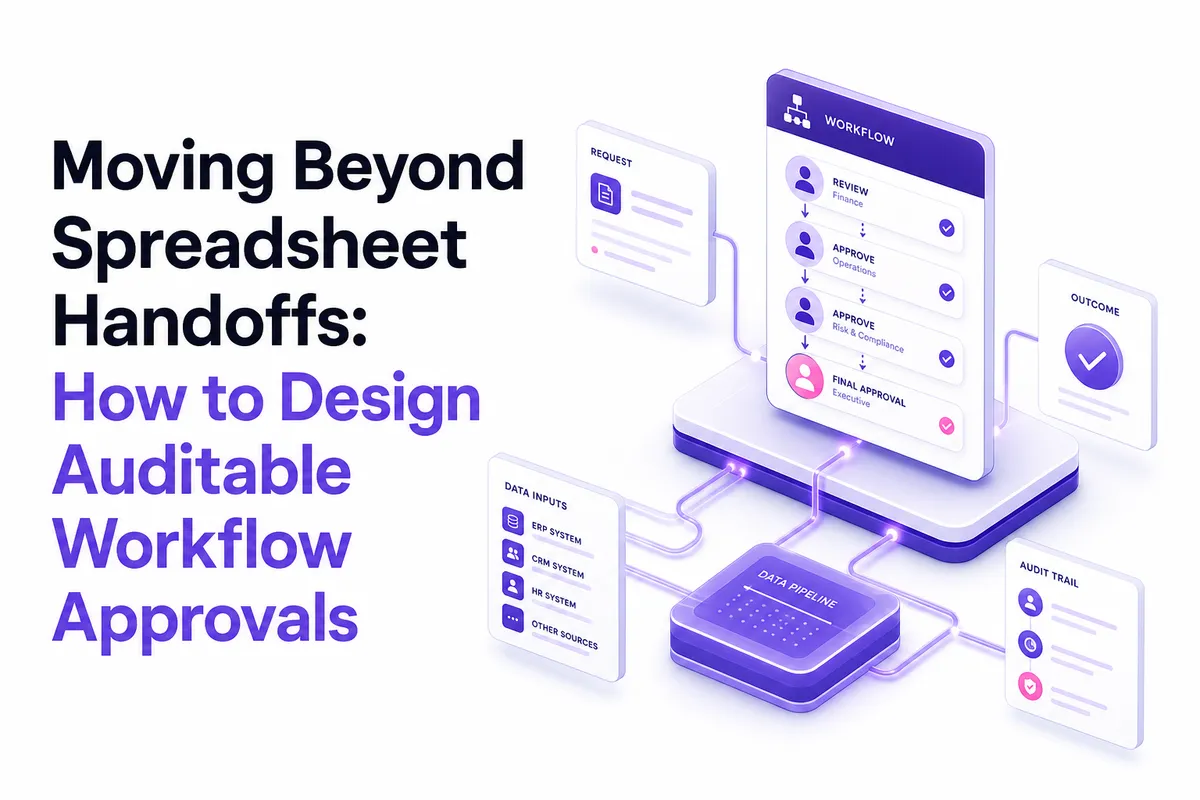
Moving Beyond Spreadsheet Handoffs: How to Design Auditable Workflow Approvals
Relying on manual spreadsheet handoffs for business approvals creates operational bottlenecks and compliance risks. Discover how structured workflow automation protects process integrity while preserving human oversight.

The Hidden Vulnerabilities of Spreadsheet-Driven Approvals
Many South African businesses rely on shared spreadsheets and email chains to manage operational approvals. Routing purchase requisitions, credit limit updates, or supplier discount sign-offs through manual workbooks initially feels convenient. However, as transaction volumes grow and multiple staff edit shared files, this informal approach creates version confusion, untracked modifications, and operational risk across departments.
When decisions depend on copying data between workbooks, critical approvals stall without clear visibility. A manager might receive a spreadsheet attachment by email but overlook the message, leaving urgent requests in limbo. Lacking automated routing or escalation reminders, department heads spend valuable time chasing status updates through phone calls, chat channels, and cluttered email threads.
Beyond operational delays, spreadsheet handoffs create governance vulnerabilities. Standard workbooks rarely record who authorized a row edit, why an exception occurred, or whether mandatory documents were checked. Reconstructing historical approval chains from scattered emails during internal reviews or audits becomes an imprecise, frustrating process that exposes the organization to compliance risks.
Understanding Human-in-the-Loop Workflow Design
Workflow automation does not mean handing operational decisions to unmonitored software. Instead, modern business process automation uses a human-in-the-loop design. Automated systems manage predictable data collection, validation, and notification tasks, but pause at designated decision gates. The workflow waits until an authorized manager evaluates the prepared evidence and renders a deliberate approval sign-off.
Placing structured review checkpoints between automated data preparation and business execution maintains clear management accountability. The automated system confirms input completeness, checks threshold rules, and compiles summary context for review. The human approver evaluates qualitative considerations, approves or rejects the submission, and triggers downstream actions without copying data across disconnected tools.
This architecture separates operational execution from decision authority. Low-risk background tasks run automatically, while high-stakes actions—such as releasing high-value orders or amending supplier contracts—remain under direct supervisor control. The automation engine logs every interaction in a central audit record, ensuring process transparency is maintained as tasks transition between operating teams.
Categorizing Controls Across the Automation Lifecycle
Effective workflow design aligns human oversight with the operational risk of each business action. Reviewing every minor data update creates severe processing bottlenecks, whereas executing high-risk financial changes without sign-off invites operational disruption. Establishing clear control tiers allows enterprises to automate routine tasks while preserving rigorous management sign-off on critical business decisions.
Operational leaders categorize workflow activities into distinct oversight levels to structure these control boundaries. This taxonomy distinguishes background data preparation, mandatory human approval gates, passive supervisor monitoring, and automated event logging. Designing each operational stage intentionally helps prevent automation bias while keeping management attention focused on high-stakes approval decisions.
Automated Data Preparation
Software validates input fields, verifies reference records, formats entries, and flags missing files automatically. This initial step reduces administrative effort before review, ensuring managers evaluate complete and structured information packages without manually verifying basic submission details.
Human-in-the-Loop Sign-off
The process pauses for explicit approval from an authorized manager before financial or contractual execution. The reviewer receives a structured transaction summary, evaluates business context, and recorded approval triggers subsequent operational steps automatically.
Human-on-the-Loop Monitoring
Low-risk routine workflows run automatically while supervisors monitor operational throughput using live management dashboards. Decision-makers maintain visibility and retain the technical authority to intervene or halt execution if anomalous data patterns emerge.
Centralized Audit Logging
System triggers, data validations, manager approvals, and downstream updates are automatically recorded with timestamps and user details. This immutable record simplifies internal compliance reviews and supports financial audit requirements across all business operations.
Four Steps to Transition from Spreadsheets to Workflows
Replacing spreadsheet handoffs with structured digital workflows requires a methodical strategy focused on process clarity. Business leaders should avoid digitizing every administrative process at once. Instead, select a single high-volume, approval-heavy workflow—such as procurement requisitions or customer credit reviews—where manual spreadsheet errors or handoff delays currently cause friction across teams.
Next, define explicit operational rules and approval hierarchies for the target process. Document required submission fields, value thresholds requiring senior sign-off, and alternative delegation paths when primary approvers are out of office. Clear rules prevent ambiguous edge cases and enable automated routing engines to assign tasks correctly without manual triage or email follow-ups.
Finally, deliver approval tasks directly into the communication tools your team uses daily, such as email or messaging applications with actionable sign-off buttons. Providing approvers with direct access to context and simple approval controls maintains operational momentum, while automated escalation rules re-route pending requests if sign-offs remain unanswered past designated deadlines.
Managing Procurement Approvals in a South African Enterprise
Consider a hypothetical South African distribution company managing several regional depots. Branch managers previously submitted purchase requisitions by editing a shared spreadsheet and emailing the file to head office. As order volumes grew, shared cells were overwritten, urgent orders sat unreviewed in busy inboxes, and finance staff spent hours matching invoices against spreadsheets to confirm purchase authorization.
Replacing this manual exchange with a digital workflow standardizes requisition intake across depots. Branch staff complete a web form that validates inventory codes and budget lines automatically. Requisitions below a set Rand limit route directly to regional managers, while larger expenditure requests trigger a secondary finance review gate containing attached supplier quotes and budget impact summaries.
In this hypothetical scenario, structured automation eliminates reliance on untracked spreadsheet handoffs. Managers receive review requests on mobile devices, authorizing purchases without stalling depot operations. The finance team gains real-time visibility over committed spending, while complete timestamped approval records remain stored in a secure repository ready for annual financial audit verification.
Governance, Data Protection, and System Safeguards
Modernizing operational approvals requires careful attention to data governance and legal obligations. In South Africa, Section 19 of the Protection of Personal Information Act (POPIA) requires responsible parties to secure personal information through appropriate, reasonable technical and organisational measures. Transitioning from unencrypted email attachments to secure workflow portals helps restrict data access to authorized personnel.
Implementing workflow software is an ongoing governance responsibility rather than a static safeguard. Organisations should regularly audit user permissions, enforce least-privilege access rules, and retain operational data only as long as necessary for business purposes. Robust user authentication, role-based access controls, and automated log management maintain process security without cluttering daily administrative routines.
Automated workflows strengthen operational resilience by removing fragile dependencies on individual inbox habits and unmonitored spreadsheet files. By pairing structured data validation with clear approval boundaries and central logging, South African companies lower turnaround delays, improve process accuracy, and maintain verifiable managerial accountability as their operational scale expands.
Important: This article provides general business information, not legal, tax or financial advice. Confirm requirements for your circumstances with a suitably qualified professional.