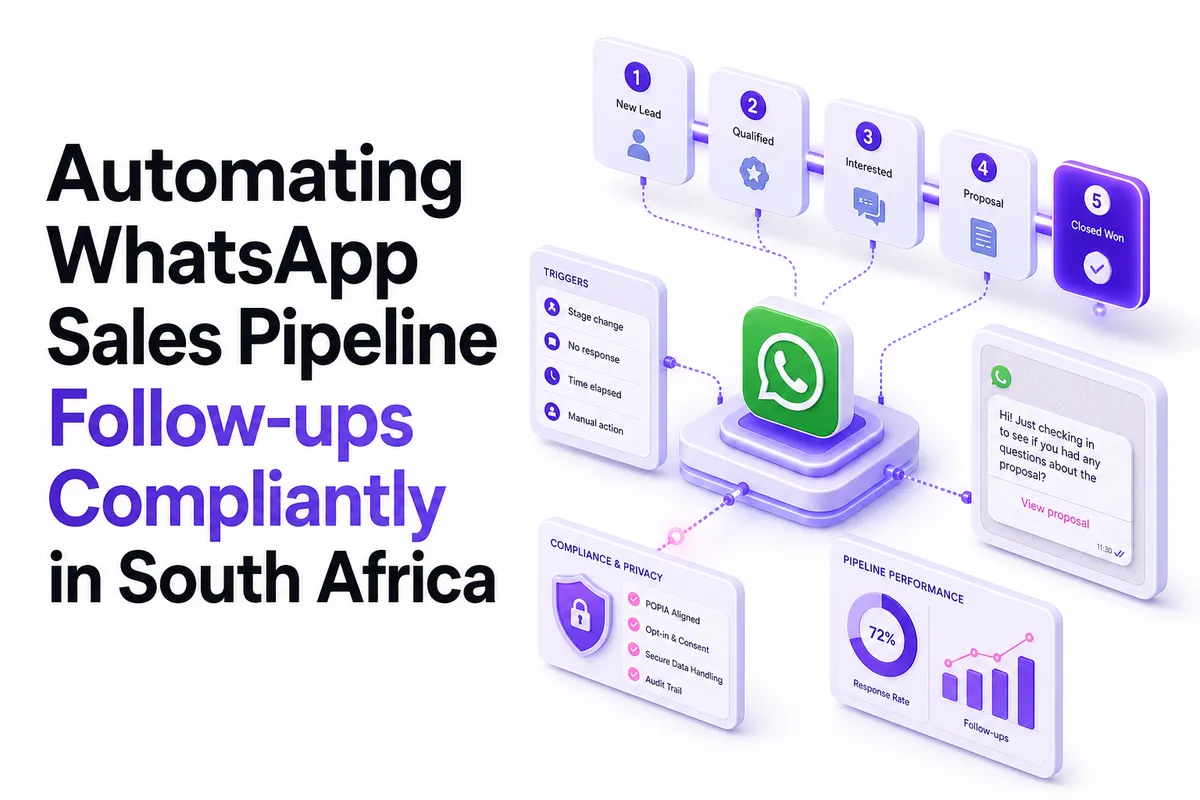
Automating WhatsApp Sales Pipeline Follow-ups Compliantly in South Africa
How South African businesses can integrate automated WhatsApp follow-ups into their CRM pipelines while remaining compliant with POPIA direct marketing requirements.
The Speed Dilemma in Modern Sales Pipelines
Prospective buyers increasingly expect a rapid response when they submit an online enquiry. South African businesses face a real tension: email outreach often arrives late or goes unread, while manual phone follow-ups consume sales capacity. Connecting automated messaging to a CRM pipeline addresses this gap by reaching prospects on a channel they check daily, within minutes of a lead capture event — without requiring a sales representative to act each time.
Without a centralised system, individual reps conducting outreach from personal devices create operational blind spots. Conversation histories disappear when staff leave, pipeline forecasting becomes unreliable, and management loses visibility into which leads have been contacted. Integrating automated messaging into a shared CRM addresses these silos by capturing every interaction in a single record, giving sales managers accurate, real-time pipeline data to work from.
Navigating POPIA Direct Marketing Rules for Messaging Pipelines
Section 69 of the Protection of Personal Information Act governs unsolicited electronic direct marketing in South Africa, covering channels such as email, SMS and automated calls. WhatsApp is treated as an electronic communication channel within this framework. In December 2024, the Information Regulator published a Guidance Note on Direct Marketing — an advisory document that is non-binding, with POPIA and its Regulations prevailing in the event of any inconsistency. The Guidance Note states that the Regulator takes the position that telephone calls and social media direct messaging also fall within Section 69's scope; however, legal commentators note that this extension remains contested, and the Regulator has indicated it is seeking a court test case to settle the question.
For non-customer prospects, Section 69 requires consent before any electronic marketing communication is sent. The one permitted outbound approach under Section 69(2) is structured as a consent request — not a product pitch. The Guidance Note advises that silence does not constitute consent, and that if no response is received, no further unsolicited electronic contact should follow. Existing customers are treated differently: under Section 69(3), businesses may continue marketing similar products or services to existing customers without fresh consent, provided contact details were obtained during a prior transaction and a clear opt-out is included in every subsequent message.
Getting Consent Right Before the Workflow Fires
The POPIA Regulations were amended with effect from 17 April 2025. Under the amended Regulations, consent for electronic direct marketing from non-customers must be obtained on a form substantially similar to Form 4 — or in any manner that is expedient, free of charge, and reasonably accessible. The previous strict Form 4 requirement has been replaced by this more flexible but still substantive standard. A pre-ticked or unticked checkbox that does not clearly specify the goods or services to be marketed, or that does not record the preferred communication channel, will still fall short of the required standard regardless of form design.
It is equally important to distinguish between an inbound enquiry and an outbound first contact. When a prospect submits a form on your website, they have initiated the interaction — that is not the same as a business reaching out to a non-customer to request consent. The one-approach constraint in Section 69(2) applies to that outbound first-contact scenario. Understanding this distinction matters operationally: it determines which leads may enter an automated follow-up sequence and which require a properly structured consent request before any marketing message is sent.
Choosing the Right Integration Model for Your CRM
The technical architecture you choose for CRM messaging integration determines your team's ability to manage lead volume, maintain compliance records, and monitor workflow health. Organisations should evaluate options based on operational scale, in-house technical capability, pipeline visibility needs, and the risk profile of their customer data — not solely on ease of initial setup.
Each model below presents distinct trade-offs. Smaller teams may find middleware connections practical as a starting point, while high-volume or regulated environments typically require the auditability and access controls that come with a direct API integration. The central criterion in every case is whether the chosen model can capture consent status, honour opt-outs promptly, and route conversations to a human representative without friction.
Standalone Mobile Apps
Zero integration effort but creates operational silos. Conversation history is tied to individual devices, consent records are untracked, and automated pipeline sequences are not possible.
Third-Party Middleware
Connects CRM triggers to messaging services without custom code. Practical for smaller operations but introduces multi-vendor data exposure and requires active monitoring for workflow failures.
Native CRM Messaging Modules
Centralises communication records alongside deal stages and simplifies access management. Messaging flexibility may be constrained by the CRM vendor's platform boundaries.
Direct WhatsApp Business API
Provides multi-agent management, template approvals, granular role permissions, and full pipeline synchronisation — the most suitable model for auditable, high-volume sales environments.
A Structured Deployment Process for Compliant Follow-Up Workflows
Before any automated sequence fires, audit every inbound lead channel and confirm that consent capture meets the current amended Regulations standard for your prospect type. Map each lead's consent status into a dedicated CRM field at the point of capture. For any outbound first-contact scenario involving non-customers, structure that initial approach as a formal consent request — not a sales message — and record the outcome. Leads without confirmed consent should be suppressed from automated marketing sequences until consent is properly obtained and logged.
Once consent records are in place, configure the workflow so that consented records trigger the follow-up sequence while non-consented records are routed to a holding stage for appropriate handling. Build opt-out processing directly into the automation: when a prospect replies with an opt-out keyword or takes an opt-out action, the CRM record should update as promptly as technically practicable and all further automated messages should cease. Test every trigger, opt-out path, and human hand-off point before go-live, and assign a named owner responsible for monitoring workflow health, template quality, and compliance record accuracy on an ongoing basis.
Safeguards, Limitations, and Ongoing Oversight
Section 19 of POPIA requires organisations to put in place appropriate, reasonable technical and organisational measures to protect personal information — selected on the basis of a risk assessment of the data being processed, not drawn from a fixed statutory checklist. In a CRM messaging pipeline, risk-based safeguards might include restricting staff access to conversation records based on role, maintaining audit logs of consent decisions, securing data in transit between your CRM and your messaging provider, and establishing a documented process for responding to data subject access requests. These are illustrative controls appropriate to the context, not a prescribed legal list.
Automated messaging also carries operational risks that governance policies must address. Aggressive message frequency or poorly targeted templates can trigger spam reports, which may result in account suspension. Regular review of template quality, send frequency, and recipient feedback can help lower this risk. Businesses should also monitor API and webhook stability continuously — a missed trigger can cause leads to drop out of the pipeline silently. Governance reviews should cover CRM access permissions, data retention schedules, and staff training on a regular cycle, ensuring the pipeline remains both commercially effective and aligned with evolving platform terms and regulatory guidance.
Important: This article provides general business information, not legal, tax or financial advice. Confirm requirements for your circumstances with a suitably qualified professional.