Designing Compliant Digital Document Workflows for South African Operations
A practical guide for South African business leaders on structuring quote automation, e-signatures under ECTA, and SARS-aligned electronic invoicing without operational or legal missteps.
Understanding Electronic Signature Standards in South African Law
As South African organisations replace paper-based administration with automated document systems, understanding the underlying legal framework is essential. The primary legislation governing digital agreements is the Electronic Communications and Transactions Act 25 of 2002 (ECTA). Under this statute, electronic documents and signatures carry full legal validity for most commercial transactions. However, the Act distinguishes between different levels of electronic signature depending on the nature of the transaction, and certain categories of agreement cannot be executed electronically at all.
For most routine commercial documents — sales quotes, purchase orders, and standard service level agreements — an ordinary electronic signature is legally recognised. Section 13 of ECTA provides that an ordinary electronic signature is valid where the method identifies the signatory, indicates their approval of the content, and is sufficiently reliable for the context. This technology-neutral standard gives organisations flexibility to capture approvals through secure digital portals, while flagging that some documents require a higher tier or fall outside ECTA's facilitative provisions entirely.
Choosing the Right Signature Level for Business Documents
Selecting the correct digital signature mechanism depends on whether a signature is required by private agreement or mandated by specific legislation. Under South African law, applying the wrong signature tier to a document that carries a statutory requirement can affect enforceability and create dispute risks. Organisations should categorise their document workflows into standard commercial transactions, statutory exceptions, tax documentation, and excluded contracts before configuring automated routing rules.
This proactive classification allows teams to implement appropriate validation gates while automating high-volume administrative tasks across sales and finance. Where uncertainty exists — particularly for documents that sit near the boundary between signature categories, or that involve land, notarisation, or court processes — qualified legal advice should be obtained before configuring workflows. Getting the classification right at the design stage is far less costly than correcting it after an enforcement dispute.
Standard Electronic Signatures
Applicable to ordinary commercial agreements, service proposals, purchase orders, and routine client approvals. Legally valid under Section 13 of ECTA provided the signing method reliably identifies the signatory and captures clear intent.
Advanced Electronic Signatures
Required where a South African statute mandates a signature without specifying the format. Issued through providers accredited by the South African Accreditation Authority. Suretyships are a well-established example. Documents requiring notarisation or certification carry separate requirements under Section 18 of ECTA and should be assessed with legal guidance.
SARS Invoicing Tiers
Under Section 20 of the VAT Act, supplies exceeding R5,000 (VAT-inclusive) require a full tax invoice with complete buyer details. Supplies between R50 and R5,000 may use an abridged invoice. Supplies of R50 or less do not require a formal tax invoice. Automated workflows must apply the correct tier based on each transaction's VAT-inclusive value.
Excluded Transactions
Schedule 2 of ECTA excludes certain transactions from electronic execution entirely. These include agreements for the alienation of immovable property and long-term leases of immovable property exceeding 20 years under the Alienation of Land Act, wills, and bills of exchange. Separately, leases of land of 10 years or longer may require additional formalities under the Formalities in Respect of Leases of Land Act 18 of 1969. Seek legal advice for your specific arrangements.
Building Document Validation into Automated Workflows
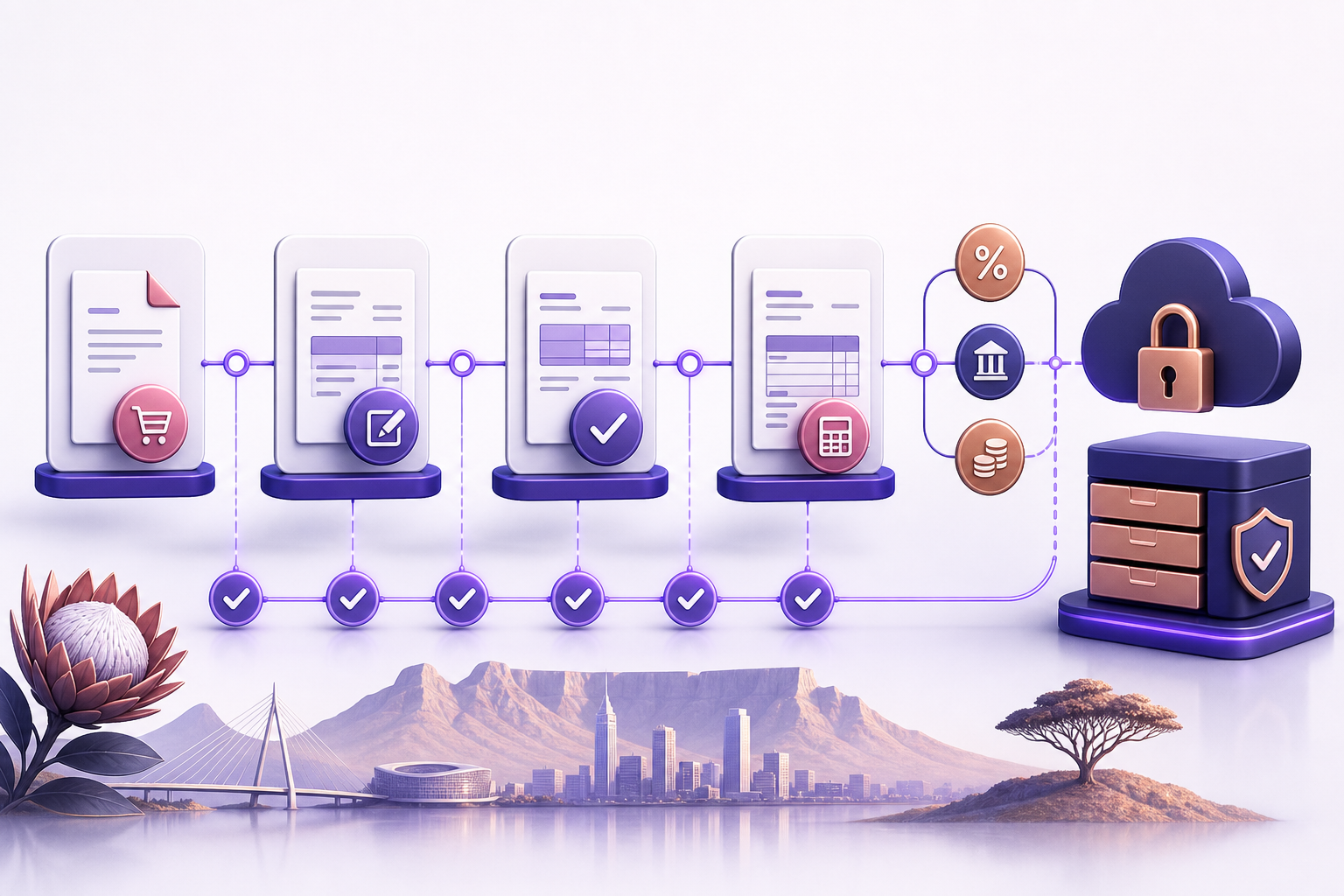
Automating the progression from sales quote to final tax invoice delivers significant speed advantages, but efficiency must be paired with strict validation. A common error occurs when automated quote generators merge unverified client data directly into billing systems. If a quote lacks complete tax information or contains invalid pricing formulas, downstream invoices may fail compliance checks and require costly manual correction.
Under the VAT Act, the invoice tier is determined by the VAT-inclusive value of the supply. For supplies exceeding R5,000, a full tax invoice must carry the supplier's and recipient's full legal names, physical or postal addresses, VAT registration numbers where applicable, a unique serialised number, and an accurate description of the goods or services. Relying on an email address alone does not satisfy these requirements. Automated workflows should apply validation gates before quote generation to confirm that the correct client details are on file for each invoice tier.
A South African Operational Example: Commercial Equipment Leasing
Consider a hypothetical Johannesburg-based commercial equipment provider that automates its quote approval and invoicing operations. Sales representatives issue digital equipment lease quotes to corporate clients. Once a client approves the quote online, the workflow automatically generates a Master Services Agreement alongside a deed of suretyship and recurring monthly tax invoices. Two compliance gaps emerge during an internal review of this hypothetical pipeline.
First, the workflow collected standard electronic signatures for the deed of suretyship, which requires an Advanced Electronic Signature. Second, the invoicing module populated client records using email addresses only, leaving generated invoices without the physical or postal addresses required for full tax invoices on supplies above R5,000. After identifying these gaps, the hypothetical business redesigned its workflow to route suretyships through an accredited signing mechanism and enforce mandatory address and VAT identifier verification before quote finalisation — steps designed to help reduce the risk of non-compliant signatures and incomplete invoices, supporting stronger contract enforceability and more consistent invoice accuracy going forward.
Five Steps to Modernise Document Validation Safely
Begin with a document mapping exercise: catalogue every agreement and invoice type your organisation issues, then assess each against ECTA's signature tiers, Schedule 2 exclusions, and VAT Act invoice requirements. For any document near a statutory boundary — particularly those involving land, guarantees, or notarisation — obtain qualified legal input before finalising the workflow configuration. Once categories are confirmed, establish strict data validation rules at the quote creation stage, enforcing mandatory client legal names, VAT identifiers, and physical addresses where the supply value will exceed R5,000.
Next, integrate signature platforms that capture robust audit metadata — timestamped consent records, signatory authentication evidence, and document integrity hashes — so that the chain of evidence is preserved if an agreement is ever reviewed in dispute proceedings. Configure your automated invoice engine to determine the correct invoice tier from each transaction's VAT-inclusive value before generating the document, and ensure serialised numbering, accurate descriptions, and correct entity details are applied at output. Finally, implement a centralised retention repository for all processed documents stored in tamper-evident, accessible formats to satisfy the five-year minimum under tax legislation and the seven-year retention requirement under the Companies Act for financial records.
Managing Storage, Privacy, and Regulatory Obligations
Document storage and data retention policies require deliberate planning. Under South African tax rules, electronic records and tax invoices must be retained for at least five years, while the Companies Act mandates a seven-year retention period for financial records. Automated document systems should maintain integrity throughout — records must remain readable, immutable, and retrievable during a SARS audit or internal review without requiring manual reconstruction.
Information privacy deserves equal attention when customer personal data flows through automated document pipelines. Section 19 of the Protection of Personal Information Act requires organisations to take appropriate and reasonable technical and organisational measures calibrated to the specific risks involved. Rather than applying a fixed set of controls, organisations should identify the foreseeable risks in their document workflows, select safeguards proportionate to those risks, and verify that those safeguards are effectively implemented and kept current as the pipeline evolves. Building this risk-based discipline now will also position organisations more readily to adapt as South African revenue authorities continue to modernise tax administration frameworks.
Important: This article provides general business information, not legal, tax or financial advice. Confirm requirements for your circumstances with a suitably qualified professional.