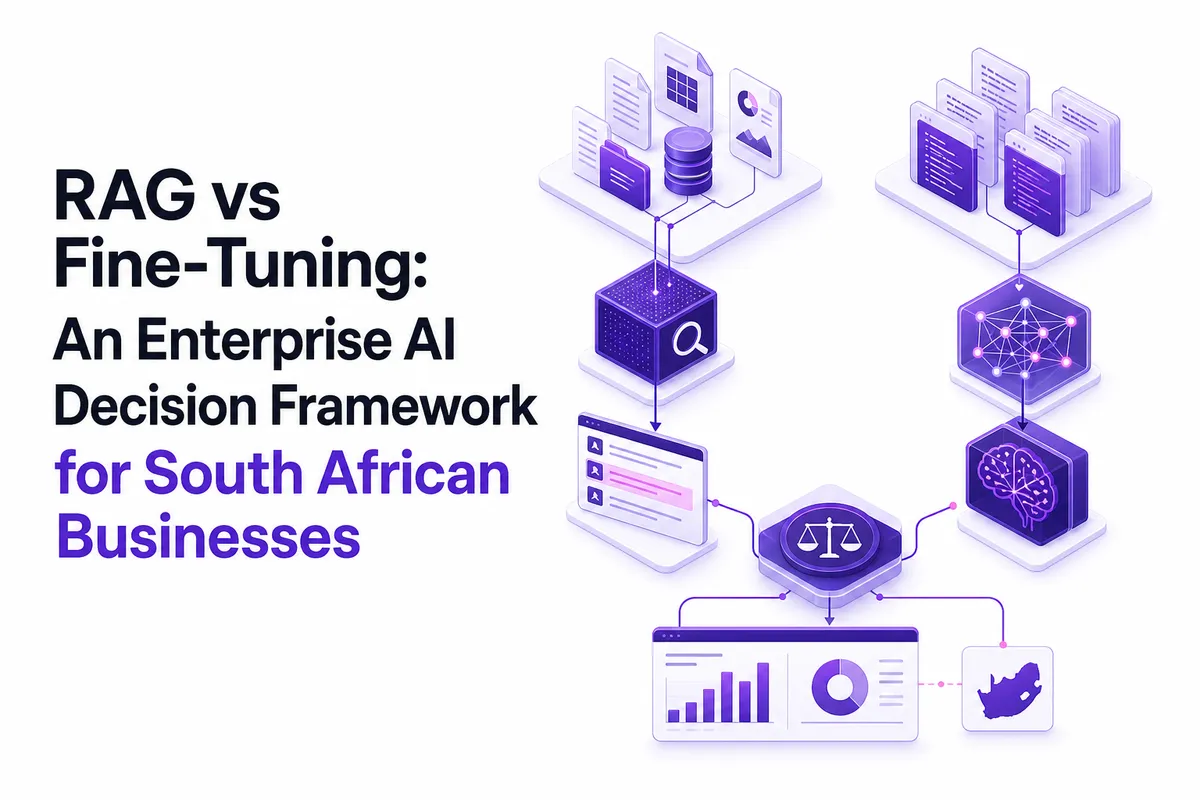
RAG vs Fine-Tuning: An Enterprise AI Decision Framework for South African Businesses
A practical executive guide to choosing between Retrieval-Augmented Generation and fine-tuning custom models for enterprise AI deployments in South Africa.

The Enterprise Custom AI Decision in 2026
As South African enterprises move beyond exploratory pilots into full operational deployment of artificial intelligence, executive teams face a foundational architectural choice: should they connect pre-trained foundation models to internal document repositories using Retrieval-Augmented Generation, or invest in fine-tuning custom models on proprietary domain data? Making the wrong choice early can generate technical debt, compliance friction, or maintenance overhead that slows organisational momentum.
Retrieval-Augmented Generation works by dynamically finding relevant internal documents at query time and presenting that context to a general-purpose language model. Fine-tuning, by contrast, modifies the model's internal weights through specialised training cycles to alter its reasoning patterns, tone, or output structure. While fine-tuning was once viewed as the primary method for teaching AI about proprietary domains, modern enterprise architecture increasingly treats dynamic retrieval as the practical default for knowledge-heavy workflows.
Evaluating Operational Trade-offs Across Four Dimensions
Selecting the right architecture requires examining specific operational criteria rather than broad performance claims. The decision framework rests on how quickly your business data updates, how strictly your industry regulates data access, and how much explainability your internal control functions demand. Most mature enterprise strategies do not treat these approaches as mutually exclusive — leading organisations start with retrieval-based architectures and introduce fine-tuning selectively only where retrieval cannot close a performance gap.
When specific workflows require a distinctive corporate tone, highly specialised output formatting, or very low latency for narrow repetitive tasks at high volume, engineering teams can fine-tune targeted models while maintaining dynamic retrieval pipelines for current context. The recommended path for most South African enterprises in 2026 is to start with RAG, measure performance gaps in production, and evaluate fine-tuning only where clear deficiencies emerge.
Data Freshness and Updating
Retrieval systems connect directly to enterprise knowledge sources, reflecting updated documents without retraining. Fine-tuned models lock knowledge into parameters, requiring periodic retraining whenever policies, regulations, or product catalogues change — and silently going stale between cycles.
Auditability and Source Grounding
Dynamic retrieval provides explicit source attribution by linking every output to specific retrieved passages. Fine-tuned models synthesise answers from internal weights, making direct source tracing significantly more difficult and increasing the risk of subtle factual errors in regulated environments.
Behavioural Customisation
Fine-tuning excels at teaching consistent output formats, domain-specific tone, structured taxonomies, or specialist vocabulary. Retrieval focuses on information injection and relies on prompt instructions rather than parameter adjustments to influence style — a limitation in narrow, high-consistency tasks.
Access Control and Governance
Retrieval architectures can help preserve existing document-level security by applying access controls before model context injection. Fine-tuning bakes information into model weights, making role-based access significantly more difficult to enforce at query time without maintaining separate model variants.
Illustrative Example: A South African Financial Services Workflow
Consider a hypothetical South African commercial credit provider evaluating automated document analysis to assist credit officers reviewing loan applications. The risk management team requires verification against financial statements, alignment with internal credit policy, and clear traceability of every recommendation. This illustrative scenario is not based on an observed deployment; actual requirements and appropriate architecture will vary by organisation.
If the enterprise selects a pure fine-tuning approach, updating the model whenever credit policies change requires full retraining cycles and output re-verification. A retrieval-based assistant, by contrast, searches the latest approved policy manual and presents exact source references alongside suggested summaries. Maintaining meaningful human review of outputs that affect individuals is good governance practice. It is also worth noting that Section 71 of POPIA restricts decisions that have legal consequences or substantially affect a data subject when based solely on automated profiling — the architectural choice does not by itself satisfy or trigger that provision. Organisations should seek qualified legal counsel for their specific obligations.
A Phased Implementation Framework for Enterprise Deployment
Transitioning from architectural evaluation to production implementation requires a structured sequence that minimises technical risk and aligns engineering output with operational objectives. South African enterprises that deploy custom AI successfully tend to follow a disciplined engineering roadmap rather than attempting immediate full-scale custom model training.
The phased journey prioritises data quality, governance boundaries, and iterative testing before scaling. Phase 1 establishes baseline data ingestion pipelines, standardising document chunking and metadata tagging. Phase 2 implements role-based search and retrieval connected to verified internal knowledge stores. Phase 3 integrates domain-specific prompt engineering, output guardrails, and human review workflows. Phase 4 evaluates production metrics to determine whether selective fine-tuning is warranted for specific tasks. This sequence helps establish a working baseline for accuracy and auditability before introducing the additional complexity of custom model training.
Data Safeguards and Regulatory Considerations under POPIA
Deploying artificial intelligence in South Africa requires aligning technical architectures with local privacy and data protection frameworks. Section 19 of the Protection of Personal Information Act requires responsible parties to implement appropriate, reasonable technical and organisational measures proportional to the risks of the specific processing activity. The selection of particular safeguards — such as access controls, logging mechanisms, or encryption — is a matter for each organisation's own risk assessment rather than a statutory checklist.
When AI systems process customer data or contribute to operational decisions, data minimisation and purpose limitation should be engineered into the retrieval pipeline. Indexing pipelines should limit personal identifiers to what is necessary, and cross-border transfer safeguards must be assessed whenever cloud-hosted foundation models are involved. Maintaining meaningful human oversight for decisions that affect individuals supports both regulatory compliance and good governance under frameworks such as King IV. Organisations should obtain qualified legal counsel to determine how POPIA provisions apply to their specific AI deployments.
Recommendations for Enterprise Technology Leaders
Enterprise technology leaders should focus initial AI investments on workflow integration, data quality, and operational governance rather than custom model training. Foundation models combined with well-architected retrieval systems offer high operational flexibility, rapid knowledge updating, and transparent source tracking for the vast majority of enterprise document processing and knowledge management use cases across South African industries.
Before committing resources to fine-tuning, executive sponsors should confirm that prompt engineering and retrieval augmentation cannot meet operational requirements. Continuous evaluation frameworks, robust monitoring, and clear ownership protocols help ensure that enterprise AI applications remain reliable and compliant as corporate data evolves. Prioritising maintainability and explainability positions South African organisations for sustainable, responsible technological transformation.
Important: This article provides general business information, not legal, tax or financial advice. Confirm requirements for your circumstances with a suitably qualified professional.