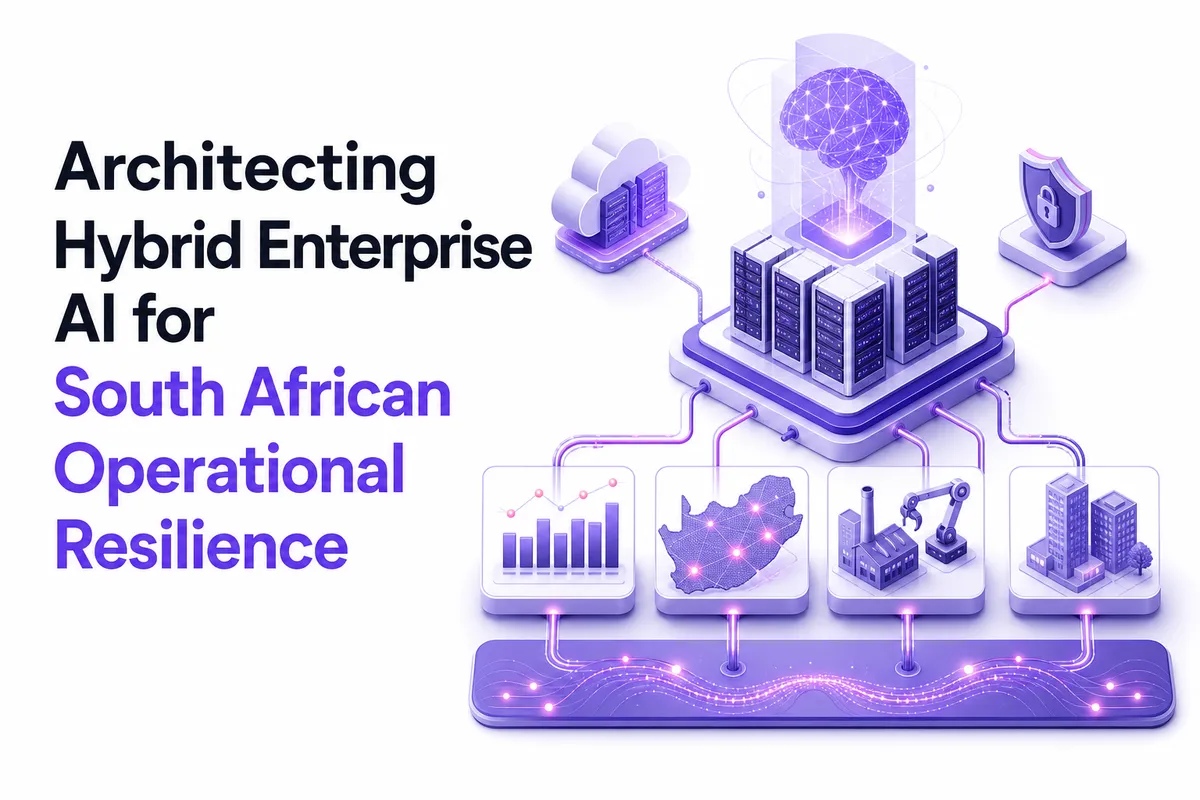
Architecting Hybrid Enterprise AI for South African Operational Resilience
A strategic guide for South African enterprises evaluating custom AI architectures, balancing cloud capabilities, data sovereignty under POPIA, and local infrastructure constraints.

Navigating AI Deployment Options in South Africa
Enterprise leadership teams in South Africa face unique decisions when integrating artificial intelligence into core operations. Beyond standard chatbots, modern enterprise workflows demand real-time data processing, seamless enterprise resource planning integration, and high reliability across urban and regional sites. Choosing the right technical architecture requires balancing complex parameters, including system responsiveness, network latency, unpredictable power availability, and operational overhead. Organisations must move past single-vendor software products toward structured architectures designed specifically for their unique regional requirements and compliance duties.
Public cloud services offer rapid deployment and access to vast general-knowledge models, but relying entirely on external APIs introduces specific vulnerabilities. System latency across international network hops can disrupt time-sensitive operations, while unexpected cloud service disruptions can pause crucial workflows. Conversely, hosting artificial intelligence infrastructure entirely on local private servers offers greater control over physical data locations, but requires substantial capital investment, internal hardware maintenance, and specialized engineering skill. Enterprise leaders must carefully weigh these trade-offs before committing capital to long-term technology roadmaps.
A resilient deployment strategy avoids all-or-nothing decisions by matching specific operational tasks to the appropriate computing tier. Highly sensitive financial records or identity documents can undergo initial filtering on private local servers, while complex general reasoning tasks utilize secure cloud platforms. This tiered approach reduces exposure to single-point operational failures, lowers bandwidth dependencies, and preserves workflow continuity during localized network or power disruptions. Establishing this operational baseline ensures that technological investment directly supports broader organizational objectives.
Comparing Key Enterprise AI Infrastructure Options
Selecting an architectural model requires analyzing operational work patterns, regulatory duties, and existing IT infrastructure across the enterprise. Different business tasks demand varying levels of compute capacity, data isolation, and processing speed. Rather than applying a single cloud model universally, successful organisations evaluate each operational workflow independently to determine where processing should occur to maintain system availability and performance.
By categorizing workflows based on risk, operational speed requirements, and regional network dependencies, engineering teams can implement targeted deployment models across distributed business units. The framework below outlines four common architectural patterns used across enterprise environments, detailing their primary operational characteristics, network requirements, and baseline suitability for specialized enterprise software applications.
Public Cloud Integration
Leverages managed external cloud endpoints for general text generation and analysis. This approach simplifies infrastructure management and provides access to advanced reasoning models, but relies heavily on stable external connectivity and requires robust transborder data handling agreements.
Private On-Premise Hosting
Deploys specialized open language models directly on company-owned server infrastructure. This structural model keeps proprietary data strictly within local hardware environments and operates independently of public cloud connectivity, offering strong operational control and offline availability.
Hybrid Gateway Pattern
Combines local preprocessing gateways with secure public cloud APIs. Proprietary operational data is sanitized and anonymized on internal servers before complex logic tasks are routed to high-capacity cloud models, balancing security with advanced processing power.
Edge Device Deployment
Runs compact language models directly on field hardware, local depot terminals, or mobile devices. This decentralized setup supports offline operations during regional network connectivity failures, maintaining continuous workflow execution across remote operational sites.
Data Sovereignty and POPIA Principles in Practice
Data protection in South Africa centers on the Protection of Personal Information Act. Section 19 obliges responsible parties to secure personal information through appropriate, reasonable technical and organizational measures. These safeguards are risk-based rather than a rigid, static checklist of required vendor certifications. Organisations must continuously identify foreseeable internal risks, establish access controls, and verify that information processing safeguards remain effective over time across all custom systems.
Cross-border data flows governed by Section 72 often cause confusion during architectural planning. The law does not impose an absolute ban on overseas cloud processing, nor does local server hosting automatically satisfy regulatory compliance. Transborder transfers are permitted under specific statutory conditions, such as binding corporate rules, standard data protection agreements, or processing in jurisdictions with equivalent privacy protections. Enterprise leaders should consult qualified legal counsel to evaluate their specific data architecture against current statutory requirements.
Implementing risk-based technical controls helps enterprises maintain operational visibility over automated systems. Effective measures include granular role-based access control, cryptographic protection for stored data, detailed access logging, and automated tokenization of personal identifiers before processing. By embedding these safeguards into the core software pipeline, businesses can protect operational data, streamline administrative auditing, and mitigate potential security incidents without compromising system utility or performance.
Hypothetical Scenario: Distributed Logistics Operations
Consider a hypothetical South African freight and logistics business operating across major transport corridors between Gauteng and coastal ports. The enterprise manages thousands of waybills, delivery notes, and customs documents daily, relying on driver mobile applications and depot terminals. Centralized cloud processing faced operational challenges when drivers entered remote regions with intermittent mobile connectivity, causing delays in cargo reconciliation and billing dispatch.
To address these operational bottlenecks, the company evaluated a custom hybrid architecture. A lightweight, locally hosted small language model was deployed on field devices and depot servers to process scanned documents offline. The local system extracted key fields, verified invoice numbers, and flagged missing signatures immediately. Once devices reconnected to central networks, non-sensitive summary metrics were synchronized with cloud analytics, while personal driver details remained stored on private infrastructure.
This hypothetical deployment illustrates how matching technical tools to local operational conditions improves system resilience. Field workers continued processing shipments during network dropouts, reducing administrative bottlenecks at freight hubs. The dual-tier setup lowered unnecessary network data usage and provided clear audit trails for compliance verification. This case demonstrates that custom workflow alignment often yields greater operational continuity than off-the-shelf cloud applications.
A Four-Stage Framework for Custom AI Deployment
Stage 1: Workflow Audit and Risk Assessment. Begin by mapping all information flows within target operational processes. Identify sensitive data fields, evaluate network stability across regional operational sites, and determine minimum processing latency requirements. Establish clear security risk profiles for each task to decide which processes require local isolation and which can safely utilize scalable public cloud resources.
Stage 2: Architecture and Gateway Engineering. Design a modular software architecture featuring secure abstraction layers between internal databases and external APIs. Build local preprocessing gateways to sanitize, filter, or tokenize sensitive inputs before transmission. Select lightweight open language models for internal server hosting and establish standard integration protocols for connecting with core enterprise resource planning platforms.
Stage 3: Validation, Deployment, and Governance. Test custom workflows under simulated operational stress, including network connectivity outages and peak workload conditions. Implement automated audit logging, role-based access controls, and ongoing system monitoring protocols. Train operational staff on system interaction guidelines and establish formal maintenance schedules to ensure long-term stability and regulatory alignment.
Maintaining Control over Proprietary Systems
Building custom enterprise capabilities requires a focus on maintainability and system ownership. Relying on fragile, custom scripts or unmanaged third-party wrapper applications increases technical debt and creates single-point operational vulnerabilities. Enterprises should insist on modular, well-documented codebases with clear software architectures, enabling internal IT teams to maintain, audit, and update system components as operational requirements evolve.
Long-term success depends on aligning custom software builds with overall business strategy. Working alongside experienced technology partners allows enterprise leaders to navigate complex architectural decisions, balance compliance duties with processing efficiency, and deploy stable solutions. By prioritizing structural resilience, clear governance, and workflow alignment, South African enterprises can build flexible digital capabilities that support sustainable operational growth.
Important: This article provides general business information, not legal, tax or financial advice. Confirm requirements for your circumstances with a suitably qualified professional.