AI-Assisted Customer Intake for South African SMEs: Practical Setup and POPIA Alignment
Learn how South African small businesses can implement AI-assisted customer intake workflows to reduce inbox clutter, accelerate response times, and align with POPIA safeguards—including obligations around automated decisions and cross-border data flows.

Moving from Manual Mailboxes to Automated Triage
Many South African small and medium businesses still manage incoming sales enquiries, support requests, and service bookings through manual email monitoring. Staff spend considerable time reading messages, identifying key details, and copying information into task tools or client databases. This pattern creates bottlenecks during busy periods, produces inconsistent responses across team members, and quietly erodes the customer experience before any service has even been delivered.
AI-assisted intake modernises this pattern by converting unstructured incoming communications into structured, actionable business records. Natural language tools analyse message text, extract relevant contact details, categorise enquiry types, and route messages to the right team member automatically. Deploying these tools does not require replacing existing systems—modern workflow automation layers over familiar email software, web forms, and CRM platforms, allowing growing businesses to maintain responsiveness without expanding administrative headcount.
Four Functions That Drive a Reliable Intake Pipeline
Building an effective intake pipeline means assigning specific, narrow tasks to automated systems rather than asking a single tool to manage the entire service lifecycle. This structured approach maintains operational clarity, reduces processing errors, and helps complex client requirements reach human specialists without unnecessary delay. Evaluating where enquiries slow down between first contact and team assignment identifies exactly where automation delivers practical value.
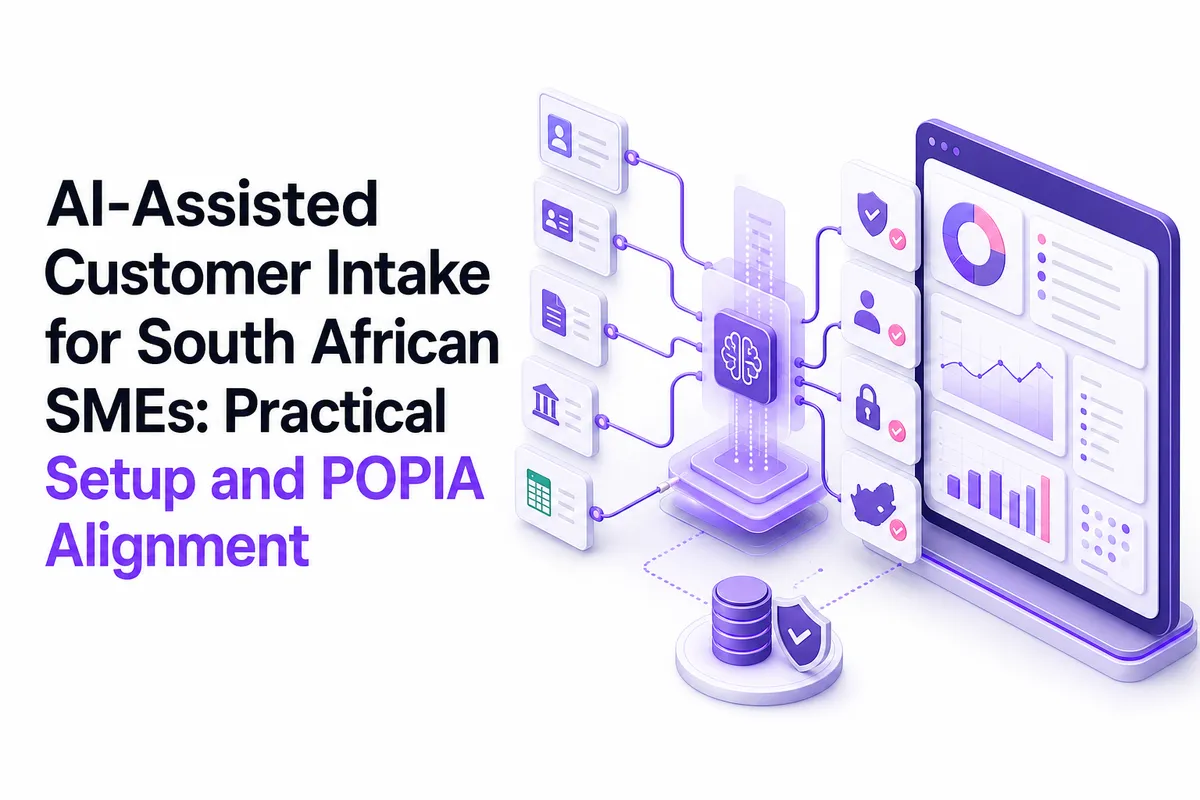
The real gain comes not from any single AI tool but from connecting lead capture, routing logic, follow-up triggers, and visibility dashboards into one coherent operating system. The four components below form the backbone of a reliable intake pipeline for service-oriented businesses.
Intent Classification
Natural language tools evaluate incoming message text to determine customer purpose—billing query, new sales enquiry, or support request—so messages reach the right queue without manual sorting.
Field Extraction and Validation
Automated scripts identify contact names, phone numbers, and account references within message text, then validate inputs against internal records before creating tasks or tickets.
Priority Scoring and Routing
Workflows assign urgency scores based on defined keywords or customer tiers, so high-priority enquiries bypass general queues and alert the right manager promptly.
Automated Initial Acknowledgements
The system generates immediate confirmation messages that set realistic response expectations, reducing duplicate follow-up calls while reassuring clients their request has been received.
POPIA Obligations Every SME Should Understand
Automating customer intake means processing personal information—contact details, identity references, and sometimes financial disclosures. Under Section 19 of the Protection of Personal Information Act (Act 4 of 2013), the responsible party must implement appropriate, reasonable technical and organisational measures to secure that personal information. The Act does not prescribe a fixed checklist of named controls.
Safeguards such as access restrictions, transmission security, and audit logging are risk-based choices made by the responsible party in proportion to the sensitivity of the data and the nature of the processing. When a business uses a third-party AI tool to process personal information on its behalf, Section 21 separately requires a written contract binding that operator to equivalent protection standards—a distinct and practically important obligation for any SME adopting a cloud-based intake tool.
Businesses should also be alert to two further provisions. First, where automated routing or classification produces a decision that results in legal consequences for a customer, or that affects a customer to a substantial degree, Section 71 of POPIA is engaged. Section 71 restricts decisions based solely on automated processing of personal information intended to profile a person, and data subjects have rights to contest such decisions and request human review.
Collecting Only What the Workflow Needs
POPIA's purpose limitation and data minimisation principles require that intake systems collect only the information necessary to fulfil the specific customer request. A well-designed intake form captures a contact name, preferred channel, and the nature of the request—nothing more at the point of first contact. Sensitive identifiers such as national ID numbers, financial account details, or health information should only enter the workflow when a specific regulated or contractual step genuinely requires them, and should be handled through secure, gated flows with expiring links rather than open chat or unstructured email threads.
Automated retention policies are an equally practical safeguard. Intake logs that are no longer needed for their original purpose should be archived or deleted according to a defined schedule, preventing the accumulation of personal records that serve no current business function. Consent must be captured at the point of first contact, with a clear statement of purpose and an easy opt-out mechanism. Logging the consent event—status, timestamp, and source—alongside each contact record creates the audit trail that demonstrates accountability to the Information Regulator if questions arise.
A Phased Approach to Deployment
Implementing automated intake works best through a deliberate, phased rollout rather than a system-wide overhaul. Starting with a single high-volume, low-risk communication channel allows teams to test routing logic, monitor classification accuracy, and adjust parameters without disrupting existing client relationships. Once team members are comfortable managing automated queues, the workflow can expand to cover additional channels and more complex routing rules. Continuous monitoring helps ensure classification logic stays accurate as customer terminology and service offerings evolve.
The practical starting points are well established: instant acknowledgement and lead capture, automated follow-up triggers, and structured routing of common customer questions. Each of these is high in volume, clearly defined, and low in risk—meaning a misclassified message is easily caught and corrected before it causes harm. The goal is not to automate every interaction but to remove the avoidable administrative friction that delays the human conversations that actually close business.
Audit Inbound Channels
Document all incoming communication streams, identify primary contact addresses and web forms, and map peak message hours to isolate where manual sorting bottlenecks occur.
Define Routing Categories
Establish clear rules mapping request types to responsible team members, with explicit escalation pathways for urgent issues and default queues for general enquiries.
Configure Safeguards and Retention
Set up field extraction, access permissions, and automated data retention parameters so daily processing aligns with your Section 19 risk assessment and Section 21 operator agreements.
Test Output and Train Staff
Run historical enquiry samples through the system to verify accuracy, then train staff to review automated outputs, adjust routing rules, and handle edge cases manually.
What Automation Handles Well—and Where It Should Step Back
To illustrate the workflow in practice, consider a hypothetical service business receiving high volumes of daily quote requests, status updates, and customer disputes across email and web forms. Without a structured system, staff read each message manually, log client details by hand, and forward queries to the correct department—a process that can be slow and inconsistent at volume. An AI intake layer in this scenario would classify incoming message intent, extract and validate contact fields, assign urgency scores, and generate immediate acknowledgements, freeing staff to focus on the substantive conversations that require judgment and relationship management.
Despite these operational benefits, automated intake has clear limits that business owners must manage actively. AI tools can misinterpret vague phrasing, informal regional terminology, or ambiguous formatting, leading to misclassified enquiries. A human-in-the-loop review mechanism for low-confidence classifications helps ensure edge cases receive manual attention before they become lost customer requests. Automation also has no place in the nuanced conversations that require empathy, negotiation, or personal judgment. The most effective model keeps automated triage at the front of the workflow and preserves direct human communication for the interactions that genuinely determine whether a client stays or leaves.
Important: This article provides general business information, not legal, tax or financial advice. Confirm requirements for your circumstances with a suitably qualified professional.